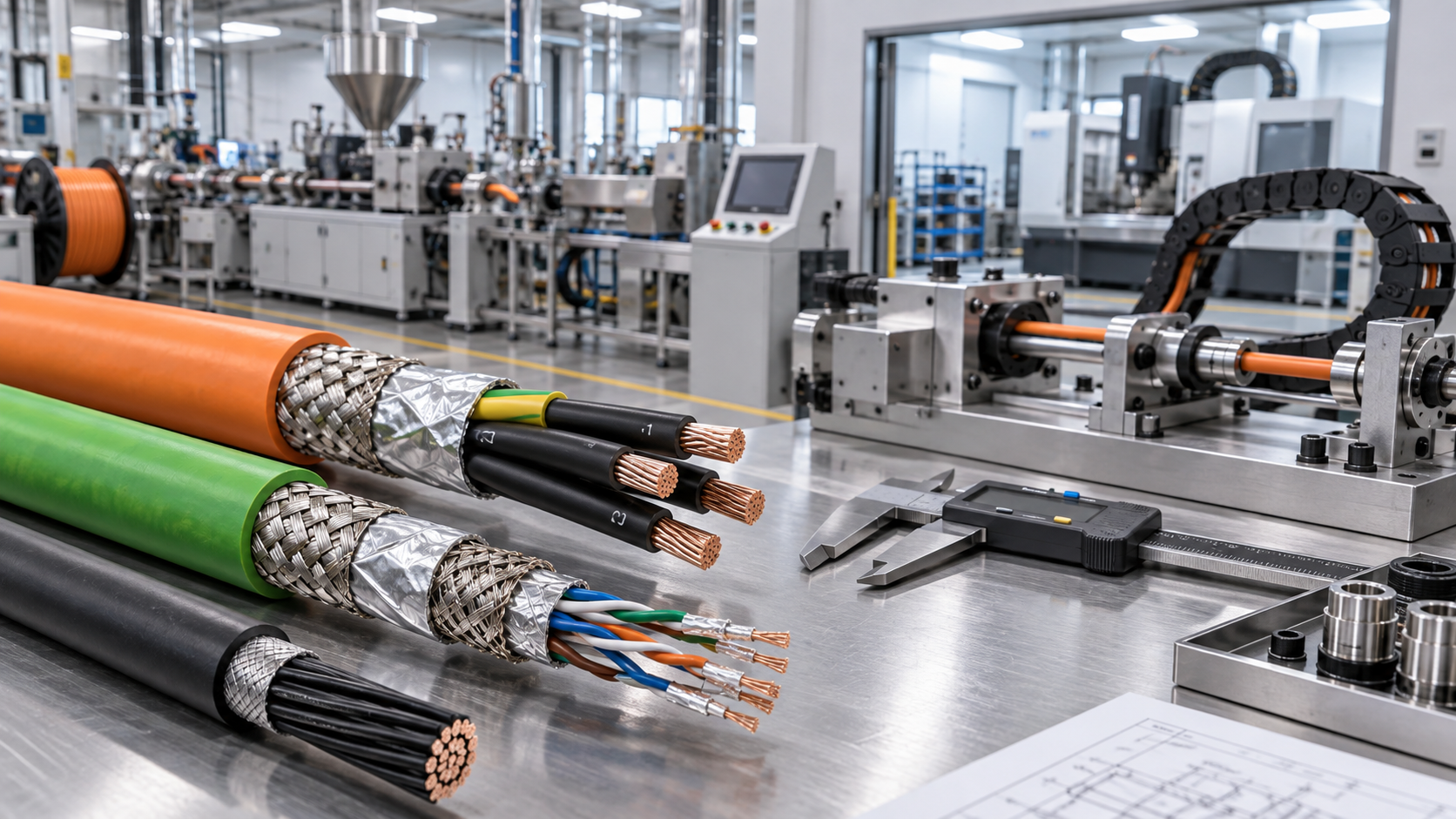
A servo cable supplier should understand both the electrical interface and the motion profile. Good copper and a flexible jacket are not enough when the cable must carry motor power, protect feedback signals and bend throughout every production shift.
Buying a servo cable is easy when the part number is already approved. The difficult job begins when a machine builder needs a different length, an alternative conductor size, a moving-cable version or a construction that can survive inside a drag chain.
At that point, selecting the right servo motor cable manufacturer matters as much as selecting the cable itself. The supplier needs to distinguish power from feedback, understand shielding and know how repeated bending changes the conductor, braid, core lay and jacket requirements.
ROLAN's servo motor cable collection includes power, shielded power, encoder and feedback constructions for automation projects. This guide explains what a buyer should check before requesting samples or placing a production order.
The phrase servo cable is used loosely. In practice, a servo axis may need two or more different cable functions.
| Cable function | What it carries | Important construction points |
|---|---|---|
| Servo motor power cable | Drive output to motor phases and protective earth | Voltage, current, conductor size, PE core, shielding and flex rating |
| Brake or auxiliary cable | Holding brake, thermal sensor or auxiliary circuits | Core count, pin assignment and conductor size |
| Encoder or feedback cable | Position, speed, resolver or serial feedback | Twisted pairs, shield design, pair identification and interface requirements |
| General control cable | I/O, sensors and machine control | Core count, shielding, voltage and movement duty |
A manufacturer that treats all servo cables as interchangeable is likely to miss important details. Power conductors and feedback pairs serve different purposes and should be specified separately.
Many products are described as flexible, but a continuous flex servo cable is designed for repeated movement during machine operation. It is different from a cable that is bent only during installation.
A capable manufacturer should ask for:
If a supplier quotes a cycle number without asking about bend radius or motion conditions, the number is difficult to evaluate. Flex life depends on cable diameter, conductor construction, shield, travel and installation—not only on the jacket material.
ROLAN's orange TSFDJ cable, for example, is a continuous-flex servo power cable designed for drag-chain movement, with published reference performance of up to 15 million bending cycles under specified conditions.
A servo power cable and a feedback cable may travel through the same carrier, but they do different jobs.
The power cable must match:
The feedback cable must match:
A practical servo power and feedback cable package may therefore contain two separate cables: a larger orange power cable and a smaller green encoder cable. Combining them into one composite cable is possible only when the electrical interface, diameter and motion design have been reviewed together.
A shielded servo cable helps control electromagnetic interference around fast-switching drives and motors. But “shielded” does not describe the complete design.
Ask the manufacturer:
ROLAN's TSFDJ-P shielded servo motor cable uses aluminium foil plus a metallic braid around the power-core assembly. The current standard range includes four-core constructions from 1.5 mm² to 6 mm², with other details subject to project confirmation.
Shielding does not replace protective earth, and there is no universal rule that every shield must be grounded in the same way. Follow the servo drive and machine EMC design.
Encoder signals are more sensitive than motor power. A generic screened multi-core cable may provide an overall shield while still lacking the correct twisted-pair geometry.
A dedicated shielded encoder cable may use:
The BMQ servo encoder and feedback cable is one ROLAN example. It uses twisted pairs, aluminium foil and tinned-copper braided shielding, with a published bending reference of up to 20 million cycles under specified conditions.
The manufacturer still needs the actual motor, encoder or drive information. Incremental encoders, absolute encoders, resolvers and proprietary feedback systems may require different pair counts and electrical characteristics.
A cable for drag chains and CNC machines must handle more than bending. CNC equipment can expose cables to high acceleration, coolant mist, oil, chips, vibration and electrical noise from motors and drives.
The cable package should be reviewed for:
A supplier familiar with CNC applications should also ask how the cables share the carrier. A heavy servo motor cable can damage a smaller feedback cable if the two are not separated correctly.
Continuous movement begins inside the cable. Important details include:
More strands do not automatically guarantee longer life. The complete conductor and cable geometry must distribute stress through the bending cycle.
For OEM orders, request the conductor structure, nominal outer diameter and production tolerance in the approved drawing. These details affect bend radius, gland selection and connector assembly.
PVC, PUR and other elastomeric materials can all be used in servo motor cable designs. The correct choice depends on the machine.
| Environment | Questions for the manufacturer |
|---|---|
| Clean indoor automation | Is standard flexible PVC sufficient for the cycle target? |
| CNC machine with oil or coolant | Has the exact fluid and exposure method been reviewed? |
| Abrasive or long-travel carrier | Is a more wear-resistant jacket required? |
| Low-temperature motion | What is the confirmed moving temperature, not just the storage temperature? |
| Outdoor equipment | Is UV and weather resistance documented for the selected compound? |
Avoid specifications such as “oil-proof” or “outdoor cable” without test conditions. Send the fluid name, temperature and whether exposure is mist, splash, washdown or immersion.
Machine builders often need more than a standard cable roll. Common custom requirements include:
Ask which changes are supported by existing tooling and which require a new construction review. Also confirm minimum order quantity, sample availability and whether final dimensions may change after the custom design is calculated.
A responsible servo motor cable manufacturer should not promise every combination immediately. Some requested structures create excessive diameter, an impractical bend radius or poor pair stability and need to be revised.
Marketing terms are useful only when production and testing support them. Before qualification, ask what documentation can be supplied for the selected model.
Relevant items may include:
Cycle testing should include bend radius, travel, speed and other test conditions. A bare statement of “10 million cycles” is not enough to reproduce or compare the result.
The sample and the production cable need to match. Cable diameter, conductor resistance, core identification, braid quality and jacket finish affect both installation and performance.
Discuss how the manufacturer controls:
For connectorised equipment, small diameter changes can affect glands, backshells and sealing. Put critical tolerances on the approved drawing before mass production.
A useful servo motor cable range should cover more than one orange power cable.
| Product group | Typical use |
|---|---|
| Non-shielded continuous flex servo cable | Motor power where the electrical design does not require an overall shield |
| Shielded servo cable | Motor power near drives and other noise-sensitive equipment |
| Servo power and feedback cable options | Coordinated power and feedback constructions for one axis |
| Shielded encoder cable | Encoder, resolver and feedback signals |
| VFD and frequency-converter cable | Dynamic motor connections requiring a dedicated VFD construction |
| Industrial sensor cable | Moving detection, measurement and sensor circuits |
These groups should be selected as a coordinated package when they share the same drag chain.
Be cautious when a supplier:
Price matters, but an incorrectly selected cable can cost more through connector changes, commissioning delays and machine downtime.
Send the following information to the manufacturer:
This information allows the supplier to recommend a real construction instead of quoting the nearest catalogue item.
Look for experience with motor power, encoder feedback, shielding and continuous motion. The manufacturer should ask for electrical data, motion profile, environment, connectors and required documentation.
No. Colour identifies the cable visually but does not prove continuous-flex construction. Check the conductor, core design, bend radius and flex rating.
The motor cable carries power and normally uses larger conductors. The encoder cable carries feedback signals and often uses small twisted pairs with dedicated shielding.
A composite design is possible, but it must be engineered for voltage separation, signal integrity, shielding, diameter and repeated movement. Separate cables are often easier to specify and replace.
Purpose-built servo cables can be used in CNC equipment when their electrical rating, flex performance, oil resistance, shielding and bend radius match the machine.
Construction, conductor size, core count, shielding, jacket colour, printing, length and packaging can be reviewed according to project requirements and production feasibility.
Choosing a servo motor cable manufacturer is not only a price comparison. The supplier should understand motor power, encoder feedback, shielding, continuous-flex construction and the mechanical limits of the drag chain.
The strongest quotation is based on real project data: drive and motor model, current, pinout, bend radius, travel, speed, environment and connector dimensions.
Explore ROLAN's complete servo motor cables, including continuous-flex power, shielded servo and encoder feedback constructions. For a custom project, contact ROLAN CABLE with your machine and cable requirements.


